
Bank customers are facing several changes in the way cash withdrawals and ATM transactions are counted. State Bank of India has announced a revised charge structure for certain Basic Savings Bank Deposit accounts, while HDFC Bank, Punjab National Bank and Bandhan Bank have also changed aspects of their ATM and cash withdrawal rules.
The changes do not affect every customer in the same way. Some relate to the number of free transactions allowed each month, while others concern daily withdrawal limits or the treatment of cardless cash withdrawals through UPI.
For customers who frequently use cash, understanding these rules can help avoid unexpected charges.
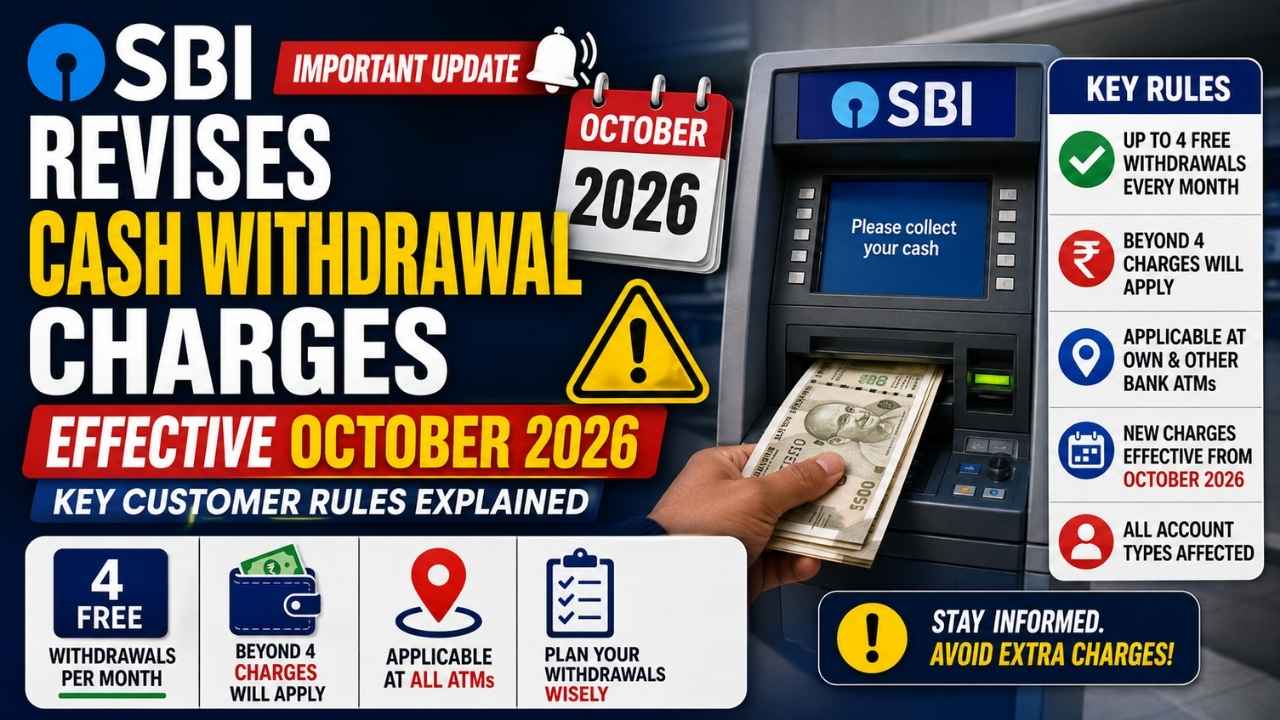
SBI to Charge ₹15 After Four Cash Withdrawals
State Bank of India has revised the cash withdrawal charges applicable to BSBD accounts opened through its branch channel.
The revised structure will take effect from October 1, 2026.
Under the new arrangement, the first four eligible cash withdrawals in a month will remain free. Once a customer goes beyond those four withdrawals, every additional eligible cash withdrawal will attract a charge of ₹15 plus applicable GST.
The charge is applied on a per transaction basis.
So, it is not a case of paying ₹15 once after crossing the limit. If several additional eligible withdrawals are made during the same month, each of them can attract the applicable fee.
SBI’s New Rule Applies to a Specific Account Category
Customers should not assume that this change applies to every SBI savings account.
The revised charge relates to Basic Savings Bank Deposit accounts opened through the branch channel.
This distinction is important because SBI offers several types of savings and deposit accounts, and their service charges can differ.
Therefore, customers should first check the type of account they hold before concluding that the new ₹15 charge applies to them.
Digital Transactions Will Remain Free
SBI has also clarified an important point for customers who prefer digital banking.
Digital transactions will continue to remain free without any restriction under this particular change.

In other words, customers do not use up the four cash withdrawal transactions simply by making digital payments.
For people who already use UPI and other electronic banking facilities for everyday payments, the revised cash withdrawal rule may therefore have limited impact.
The change is primarily relevant to customers who regularly need physical cash.
Frequent Cash Users Could Feel the Difference
The new SBI rule is more relevant for customers who make several cash withdrawals during a month.
For example, a customer could withdraw cash once in the first week, twice in the second week and once again later in the month. That would use all four free withdrawals.
If the customer then makes another eligible cash withdrawal, the additional transaction would attract ₹15 plus GST.
This means customers who make multiple small withdrawals may need to pay more attention to the number of transactions they make.
HDFC Bank Brings UPI Cash Withdrawals Into the Count
HDFC Bank has also changed how certain cash withdrawal transactions are treated.
Under the revised arrangement, UPI-based cardless cash withdrawals are included when calculating the customer’s monthly free ATM transaction limit.
This is significant because customers using UPI to withdraw cash may previously have viewed cardless transactions differently from conventional ATM withdrawals.
With the revised approach, a customer can reach the free transaction limit sooner if both traditional ATM withdrawals and UPI-based cash withdrawals are being used.
HDFC Bank’s Free ATM Transaction Limits
For HDFC Bank customers, the applicable free transaction allowance depends on where the ATM is located and whether it belongs to HDFC Bank or another bank.
The stated limits include five free transactions at HDFC Bank ATMs each month.

For other bank ATMs, the allowance is three free transactions in metro locations and five in non-metro locations.
Once the applicable free limit has been exhausted, charges can apply.
HDFC Bank’s stated charge for an additional transaction is ₹23 plus applicable taxes.
The key point is that UPI-based cardless withdrawals are now relevant when customers calculate their available free transactions.
Why the HDFC Change Matters
Cardless withdrawals have become increasingly convenient because customers can access cash without physically inserting a debit card into an ATM.
However, convenience can also make it easier to make more frequent withdrawals without realising that each transaction may count toward the monthly allowance.
A customer could use a debit card for some withdrawals and UPI for others and still reach the applicable limit.
Therefore, customers who regularly use both methods should keep track of their total eligible transactions.
PNB Reduces Daily Cash Withdrawal Limits
Punjab National Bank has made a different type of change.
Instead of primarily changing the number of free monthly transactions, PNB has revised the maximum amount that can be withdrawn in a day for certain debit card categories.
Some cardholders have seen their daily withdrawal limits reduced significantly.
For example, the daily limit for certain Platinum, Gold and Business debit cards has been reduced from ₹1 lakh to ₹50,000.
For certain Select and Signature debit cards, the limit has been reduced from ₹1.5 lakh to ₹75,000.

This represents a reduction of up to 50% for the affected categories.
PNB Customers Need to Check Their Card Category
The revised PNB limits are not necessarily identical for every debit card.
Customers therefore need to identify the specific card variant they hold before assuming that the ₹50,000 or ₹75,000 limit applies to them.
This is particularly important for customers who occasionally make high-value cash withdrawals.
Someone who normally withdraws only a few thousand rupees may never notice the change. But customers who rely on higher daily cash limits could be directly affected.
Why Daily Withdrawal Limits Matter
A reduction in the daily cash limit does not necessarily prevent a customer from accessing the required amount altogether.
However, it could mean that a large withdrawal has to be divided across multiple days, depending on the bank’s rules and the customer’s circumstances.
For businesses and individuals who regularly deal with larger cash requirements, the revised limit could therefore require additional planning.
It can also encourage customers to use electronic transfer methods for transactions where cash is not essential.
Bandhan Bank Also Revises ATM Transaction Rules
Bandhan Bank has updated its free ATM transaction structure as well.
The bank differentiates between financial and non-financial ATM transactions.
Under the stated structure, customers receive a specified number of free financial transactions, while non-financial transactions can have a different treatment.
For other bank ATMs, three free transactions are available in metro locations and five in non-metro locations under the applicable structure.

Once the relevant free limit is crossed, charges can apply according to the bank’s service-charge schedule.
Metro and Non-Metro Locations Can Make a Difference
The number of free transactions available at other bank ATMs can depend on whether the transaction takes place in a metro or non-metro location.
The metro locations listed for this purpose include Mumbai, New Delhi, Chennai, Kolkata, Bengaluru and Hyderabad.
Customers using ATMs outside these locations may fall under the non-metro transaction allowance.
This makes the location of the ATM another factor customers should consider when estimating how many free transactions remain.
The Common Theme Across These Changes
Although SBI, HDFC Bank, PNB and Bandhan Bank have made different changes, there is a common theme.
Banks are paying greater attention to how customers use cash and ATM facilities.
Some transactions that customers may previously have considered separate are increasingly being brought under common transaction limits.
UPI-based cardless withdrawals are one example.
At the same time, banks are adjusting daily cash limits and charges for transactions beyond the free allowance.
Customers Should Not Confuse Monthly Limits With Daily Limits
One of the easiest mistakes is to treat all withdrawal restrictions as the same.
SBI’s revised BSBD rule concerns the number of eligible cash withdrawals during a month.
HDFC Bank’s rule deals with how ATM and cardless transactions contribute to the applicable free transaction allowance.

PNB’s change primarily concerns how much cash can be withdrawn in a single day for specified debit card categories.
These are different types of restrictions.
A customer should therefore check both the transaction count and the maximum withdrawal amount applicable to their particular account or card.
How Customers Can Avoid Unnecessary Charges
The simplest approach is to keep track of cash withdrawals rather than making repeated small transactions without checking the applicable limit.
Customers can also use digital payment methods for routine purchases where convenient.
Before making a large cash withdrawal, PNB customers should verify the daily limit associated with their debit card.
HDFC Bank customers who use UPI-based ATM withdrawals should remember that these transactions can contribute to the relevant monthly free limit.
SBI BSBD account holders should keep track of their four free eligible cash withdrawals before making additional withdrawals.
The Bottom Line
The latest banking changes show that customers can no longer look only at the amount they withdraw. The number of transactions, the withdrawal method, the location of the ATM and the type of account or debit card can all affect the applicable charges or limits.
For SBI BSBD account holders, the important date is October 1, 2026, when eligible cash withdrawals beyond four in a month will attract ₹15 plus applicable GST per transaction.
HDFC Bank customers need to remember that UPI-based cardless cash withdrawals can count toward the applicable free ATM transaction limit.
PNB customers with certain debit cards should check the revised daily withdrawal ceiling, with some limits reduced by as much as 50%.
Bandhan Bank customers should also be aware of the distinction between financial and non-financial transactions and the different allowances applicable to metro and non-metro ATM usage.
Before making an important cash withdrawal, customers should check the latest service-charge schedule applicable to their specific account or card. Bank rules can differ considerably, and the final charges depend on the product and transaction involved.