
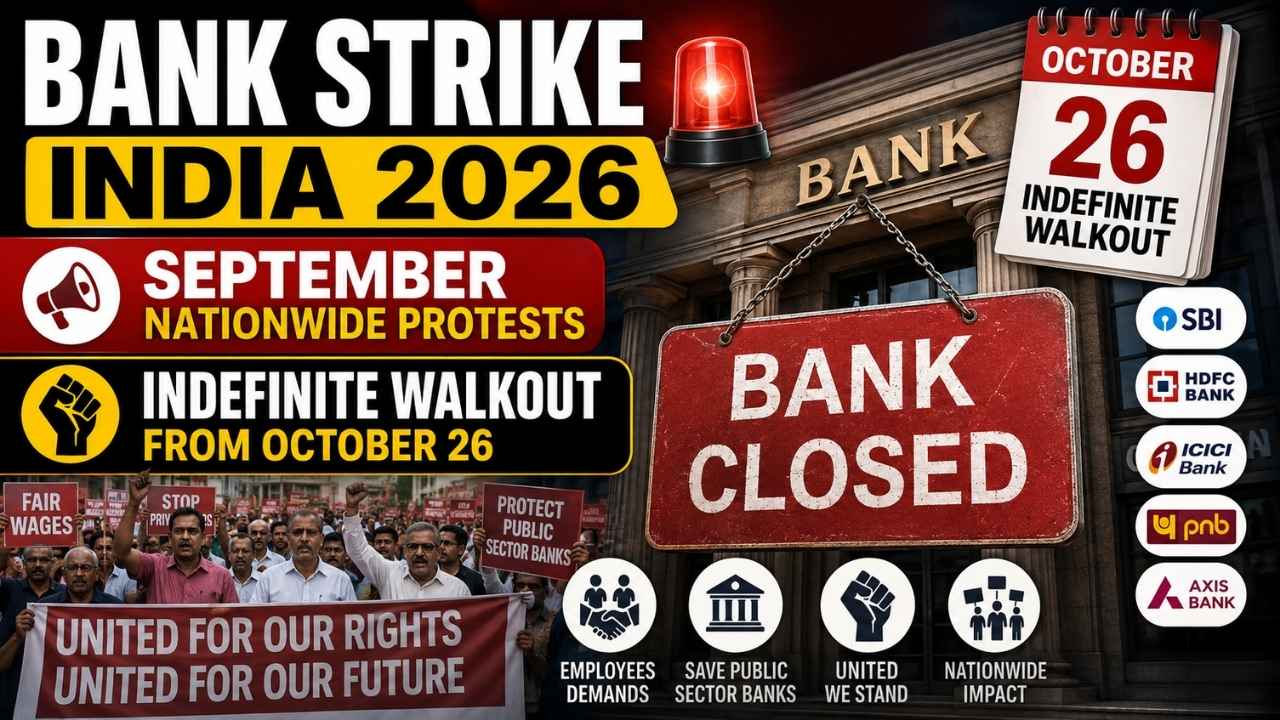
Bank customers may face disruptions in banking services as the United Forum of Bank Unions has announced a series of nationwide strike actions over several demands related to working conditions and banking sector policies.
The forum, which represents several major bank employee and officer unions, is seeking changes including a five day working week and a review of the Performance Linked Incentive system.
The proposed action is significant because UFBU brings together multiple unions representing employees and officers across the banking sector. If the strike programme goes ahead as announced, customers could experience interruptions at branches and in some routine banking services on affected dates.
Why Are Bank Employees Planning the Strikes?
The central issue behind the proposed agitation is a set of long standing demands concerning working arrangements, employee benefits and the broader functioning of the banking sector.
One of the most prominent demands is the introduction of a five day banking week.
Bank employees and unions have been seeking a system in which banks operate with employees working five days a week, with Saturdays and Sundays treated as weekly holidays.
The unions have argued that banking employees should receive working arrangements similar to several other sectors where a five day week has already become standard.
Five Day Banking Week Remains a Major Demand
The five day work week is not a new demand from bank unions.
Employee organisations have repeatedly raised the issue, arguing that changes in technology and digital banking have transformed the way customers access financial services.
Most customers now have access to mobile banking, internet banking, ATMs and digital payment platforms outside traditional branch hours.
Unions believe these changes should be accompanied by an updated working arrangement for bank employees.
The demand, however, would require agreement between the government, banks and relevant stakeholders before it could become a nationwide policy.

What Is UFBU?
The United Forum of Bank Unions is an umbrella organisation representing several banking unions.
The organisations associated with the current strike programme include AIBEA, AIBOC, NCBE, AIBOA, BEFI, INBEF and INBOC.
By coordinating industrial action through a common platform, these unions can present their demands collectively rather than negotiating separately.
This also means that any nationwide strike called under the UFBU banner can potentially involve employees across a large section of the banking industry.
What Is the Performance Linked Incentive Issue?
Another major demand concerns the Performance Linked Incentive, commonly known as PLI.
The system links part of employee compensation to performance and other specified parameters.
Bank unions have called for a review of the existing PLI framework.
Their position is that the incentive system should be examined to ensure that employees receive an appropriate benefit from improvements in productivity and performance.
The details of the unions’ proposed changes and the government’s response will determine how the issue develops.
The Unions Are Also Seeking the Government’s Intervention
The strike programme is intended to put pressure on the authorities to address the demands raised by the banking unions.
The unions have called on the government to honour commitments and take action on issues that they say remain unresolved.

Such industrial action is generally used as a negotiating tool. The possibility of strikes can encourage discussions between employee representatives, banks and the government before the proposed dates arrive.
If negotiations produce an agreement, the programme could potentially change.
What Could the Strike Mean for Bank Customers?
For customers, the biggest concern is whether routine banking services will be affected.
On strike days, branches may remain closed or operate with limited staff depending on the scale of participation.
Customers planning to visit a branch for services such as cash deposits, withdrawals, account-related work, document submission or other counter services could therefore face delays.
The extent of disruption will depend on participation by employees and the specific banks and locations affected.
Digital Banking May Continue to Be Available
A bank strike does not necessarily mean that every banking service stops.
Digital channels such as mobile banking, internet banking and UPI can continue to provide many services independently of branch operations.
ATMs may also remain operational, although cash availability can vary depending on replenishment and local circumstances.
Customers should therefore distinguish between branch-based services and electronic banking facilities.
However, a customer who needs a service that can only be completed at a branch should not wait until the last moment.

Customers Should Plan Important Branch Visits
Anyone who has an important banking task coming up should check the announced strike schedule before visiting a branch.
This is particularly relevant for customers who need to submit physical documents, complete certain account-related formalities or access services that cannot be completed digitally.
Planning ahead can help avoid unnecessary trips and delays.
Customers can also use their bank’s official website, mobile application or customer support channels to determine whether a particular service can be completed online.
Will ATMs and UPI Stop Working During a Strike?
Customers should not automatically assume that ATMs, UPI and other digital services will stop because bank employees are on strike.
These services are supported by technological infrastructure and can continue operating even when physical branches are affected.
However, individual service availability can vary because of technical issues, cash replenishment requirements and other operational factors.
For this reason, customers who expect to need cash during a strike period may prefer to plan their requirements in advance rather than waiting until the last day.
Could Bank Holidays Increase the Impact?
The impact of a strike can become more noticeable when it falls close to weekends or scheduled bank holidays.
If a branch closure caused by industrial action is followed by a regular holiday, customers could experience a longer gap before normal branch operations resume.
This makes the exact strike dates particularly important.

Customers should check the final schedule and their bank’s announcements rather than relying on general social media messages or old strike calendars.
What Happens If Negotiations Succeed?
A strike announcement does not necessarily mean that every proposed strike will ultimately take place.
Industrial disputes can develop rapidly when negotiations resume.
If the government, banks and unions reach an understanding, the proposed action could be modified, postponed or withdrawn.
Therefore, customers should look for the latest official updates before making assumptions about branch closures.
Why the Five Day Week Demand Matters Beyond Bank Employees
The five day work week could have broader implications for customers and the banking industry.
A shift to a five day working arrangement would change the traditional banking calendar and could result in fewer Saturdays being available for physical branch services.
At the same time, banks could place greater emphasis on digital channels and automated services.
For customers who rarely visit branches, the change might have little practical effect.
For customers who depend heavily on branch banking, however, the timing of visits could become more important.
What Bank Customers Should Do
Customers do not need to panic over the strike announcement, but some basic preparation can be useful.

Keep sufficient cash available for essential expenses if a branch closure is expected.
Complete urgent branch-related work before the affected dates where possible.
Use mobile banking, internet banking and UPI for routine transactions.
Check the official communication from your bank for any changes in operating arrangements.
If you have a cheque, document submission or other time sensitive banking requirement, verify the processing timeline in advance.
The Bigger Issue for the Banking Sector
The current dispute highlights the changing relationship between traditional branch banking and digital financial services.
Customers increasingly expect banking to be available around the clock through smartphones, while employees continue to work within established branch and operational structures.
The demand for a five day week reflects this changing environment, while the PLI debate focuses on how employees should be rewarded for performance and productivity.
How the government and banking management respond to these demands could influence employment practices across the sector.
Final Takeaway
The United Forum of Bank Unions has announced nationwide strike action and an indefinite strike as part of its campaign for changes in the banking sector.
The five day working week and revision of the Performance Linked Incentive scheme are among the key issues being raised.
For customers, the immediate concern is the possibility of disruption at physical bank branches on strike days. Digital banking services may continue to provide many routine facilities, but customers with important branch-related work should plan ahead.
The situation could change if negotiations between the unions, banks and the government result in an agreement.
Therefore, customers should rely on the latest official announcements for confirmed strike dates and service arrangements rather than treating the initial strike programme as the final schedule.