
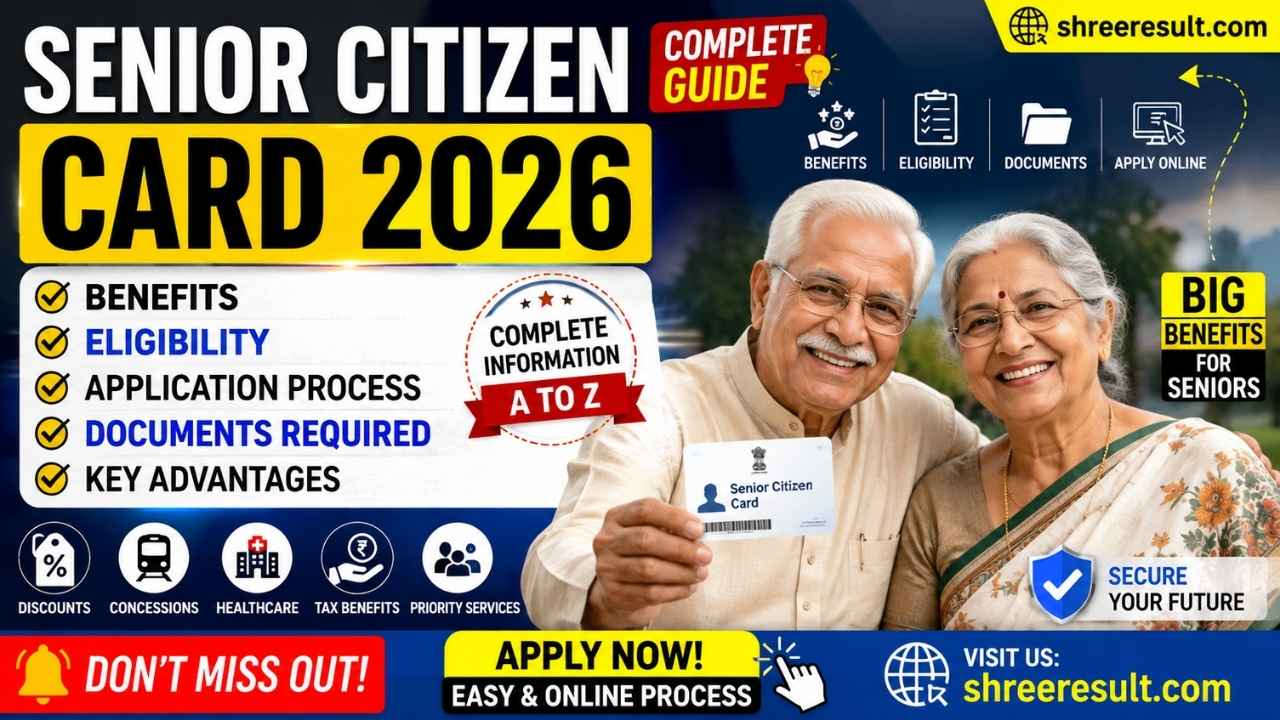
Turning 60 is an important milestone in India, and it can also open the door to several benefits designed specifically for senior citizens. From concessions and priority services to tax deductions and access to certain government schemes, people aged 60 and above may be entitled to benefits that are not available to younger citizens.
One document that can make it easier to establish senior citizen status is the Senior Citizen Card. Depending on the state, this card may be issued by the state government or the concerned local authority and can serve as an identity and age verification document when applying for eligible services.
However, it is important to understand that a Senior Citizen Card does not automatically provide every benefit available to senior citizens. Different benefits have their own eligibility conditions, and some schemes require separate registration.
Here is a complete guide to the Senior Citizen Card 2026, including who can apply, documents required, major benefits, tax advantages and important points to remember before applying.
What Is a Senior Citizen Card
A Senior Citizen Card is an identity document used to establish that a person qualifies as a senior citizen under the applicable rules. In most cases, senior citizen status begins at the age of 60.
The exact name, issuing authority, application process and benefits associated with the card can differ from one state to another. Some states provide dedicated senior citizen cards, while others use government databases, certificates or other identity documents to establish eligibility.
The card can be useful when accessing services where proof of age or senior citizen status is required. Instead of repeatedly explaining your eligibility, having an official document can make verification easier.
It should not, however, be confused with Aadhaar, ABHA or an Ayushman Bharat health card. These documents serve different purposes.
Who Can Apply for a Senior Citizen Card
The basic eligibility requirement is generally straightforward. An applicant must have reached the prescribed senior citizen age, which is normally 60 years.
Indian citizenship is generally required, along with proof of residence in the state or jurisdiction where the application is being submitted.
A person does not normally lose senior citizen status simply because they are still working. Someone who is 60 or older may continue to work in a private company, government organisation or their own business and can still qualify as a senior citizen.
The important requirements usually include the following:
Age of 60 years or above
Indian citizenship
Proof of residence in the relevant state
Valid identity documents

Proof of date of birth or age
The precise eligibility conditions should always be checked on the official portal or with the concerned state authority because state rules and application procedures can differ.
Documents Required for Senior Citizen Card
Applicants generally need documents that establish their identity, age and address.
For identity verification, documents such as Aadhaar Card, Voter ID, Driving Licence or a pension related identity document may be accepted.
For age verification, a birth certificate, passport, school leaving certificate or another government recognised document showing the date of birth may be required.
Address verification can usually be established through documents such as a passport, utility bill, registered sale deed or other officially accepted proof of residence.
Applicants should keep both original documents and clear copies available. Online applications may require scanned copies or photographs of the documents.
The exact list can vary between states, so applicants should check the latest document requirements before submitting their application.
How to Apply for a Senior Citizen Card
The application process depends on the state in which you live.
In states where online applications are available, applicants may need to visit the official government portal, create an account or log in, select the relevant senior citizen service and enter their personal details.
The applicant may then have to provide their date of birth, residential address, contact details and other information requested by the department.
After uploading the required documents, the application can usually be submitted online. Some applications may require verification by the concerned authority before the card or certificate is issued.
In areas where online applications are not available, applicants may have to submit the form through a designated government office, local authority or social welfare department.
Before applying, make sure that the name, date of birth and address shown on your supporting documents are consistent. Differences between documents can sometimes result in delays during verification.
If you have recently moved from one state to another, it is also sensible to ensure that your current address documents are updated before applying.

What Benefits Can Senior Citizens Get
The benefits available to senior citizens vary considerably depending on the state, central government scheme, service provider and individual eligibility.
A Senior Citizen Card can make it easier to establish eligibility for certain concessions and priority services, but possession of the card does not automatically guarantee every senior citizen benefit.
Healthcare is one of the areas where senior citizens may receive priority or concessions. Government hospitals and certain healthcare institutions may provide priority registration, separate queues or discounted services according to their own rules.
Some private hospitals and diagnostic centres may also offer senior citizen discounts, although these are generally determined by the individual institution.
Senior citizens may also receive concessions or special facilities on certain state operated public transport services. The availability and amount of any concession depend on the relevant transport authority.
Some banks provide special interest rates or other facilities for senior citizens on fixed deposits and other deposit products. These benefits are generally linked to the person’s age and the bank’s rules rather than the Senior Citizen Card itself.
Senior citizens can also qualify for government backed savings schemes such as the Senior Citizens Savings Scheme, subject to the scheme’s specific eligibility requirements.
In some circumstances, senior citizens may also receive priority assistance when accessing government services.
Senior Citizen Card and Healthcare Benefits
A common misunderstanding is that a Senior Citizen Card itself provides free healthcare.
That is not necessarily the case.
The card primarily helps establish senior citizen status. Healthcare coverage depends on the particular government programme, state scheme, hospital or insurance policy involved.
For example, eligibility for Ayushman Bharat or another government health scheme is determined under that scheme’s own rules. A person should not assume that receiving a Senior Citizen Card automatically means they are enrolled in a health insurance or cashless treatment programme.
Senior citizens should therefore check separately whether they qualify for government health coverage, health insurance benefits or state specific healthcare schemes.
Senior Citizen Tax Benefits in 2026
Tax treatment is one of the most important areas for people approaching or crossing the age of 60.
Under the old tax regime, individuals who qualify as senior citizens can receive certain tax benefits that are not available in the same form to younger taxpayers.

For senior citizens between 60 and 80 years of age, the basic exemption limit under the old tax regime is higher than the exemption limit applicable to individuals below 60.
Individuals aged 80 years or more are generally treated as super senior citizens for certain income tax provisions and may receive a higher basic exemption limit under the old regime.
Another important provision is Section 80TTB. Eligible senior citizens can claim a deduction on qualifying interest income from deposits, subject to the applicable limit and conditions.
Senior citizens may also benefit from the higher deduction available under Section 80D for eligible health insurance premiums.
Section 80DDB can provide a deduction for certain medical treatment expenses involving specified diseases, subject to the conditions and limits prescribed under the Income Tax Act.
These provisions can be particularly relevant for retired individuals who receive pension income, bank interest or other eligible income.
Senior Citizens and Advance Tax
Another useful provision concerns advance tax.
A resident senior citizen who does not have income from a business or profession may be exempt from the requirement to pay advance tax under the applicable provisions.
This can simplify tax compliance for retired individuals whose income mainly comes from sources such as pension, interest and investments.
However, taxpayers should not assume that they are automatically exempt in every situation. Their income sources and tax circumstances need to be considered before deciding whether advance tax payments are required.
Tax Filing Rules for Senior Citizens Above 75
There is also a special provision for certain resident senior citizens aged 75 years or above.
Where the prescribed conditions are satisfied, including having pension and interest income from the specified bank, the individual may be eligible for relief from filing an income tax return.
The applicable declaration and documentation requirements must still be completed with the bank.
This provision is intended to simplify tax compliance for eligible elderly taxpayers who have a limited and specified type of income.
Anyone considering this facility should check the latest income tax rules and forms for the relevant assessment year before relying on the exemption.

Old Tax Regime or New Tax Regime
Senior citizens should not automatically assume that the old tax regime is always better.
The new tax regime has become the default tax system and provides different tax rates and deductions. The old regime, on the other hand, allows taxpayers to claim several deductions and exemptions if they meet the relevant conditions.
For a senior citizen with substantial bank interest, eligible medical expenses, insurance premiums and other deductions, the old regime may sometimes produce a lower tax liability.
For another taxpayer with fewer deductions, the new regime may be more beneficial.
The best choice depends on total income, pension, interest income, deductions, investments and other financial details.
A simple comparison of tax liability under both regimes is therefore better than choosing one regime solely because of age.
Senior Citizen Card Is Not the Same as Every Senior Citizen Benefit
This is an important point that applicants should remember.
The Senior Citizen Card is primarily a way of establishing senior citizen status. It does not replace every other identity document or scheme specific registration.
For example, a person may need separate enrolment for a health insurance programme. A bank may require its own age verification for senior citizen deposit rates. A transport authority may have separate requirements for a travel concession.
Similarly, income tax benefits are governed by the Income Tax Act and applicable tax rules. A Senior Citizen Card is not what creates the tax benefit.
Age and the taxpayer’s circumstances determine eligibility under the relevant tax provisions.
Things to Check Before Applying
Before submitting an application, check whether your state currently provides a dedicated Senior Citizen Card and identify the correct issuing authority.
Make sure your date of birth is correctly recorded on your identity documents.
Check that your residential address matches the state requirements.
Keep clear copies of your documents ready if applying online.

Do not pay an unofficial agent simply because they claim that a card is mandatory for every senior citizen benefit.
Most importantly, verify the latest information through the official government department or state portal because rules and procedures can change.
Final Words
A Senior Citizen Card can be a useful document for people aged 60 and above because it provides a convenient way to establish senior citizen status when accessing eligible services.
The benefits can include priority services, certain healthcare or transport concessions and easier verification for age related facilities. Senior citizens may also qualify for important tax benefits under the applicable tax regime, although these benefits come from tax law rather than from the card itself.
The most important thing to remember is that turning 60 does not automatically activate every benefit. Different schemes have different eligibility requirements, and some require separate registration.
If you or a family member has recently turned 60, it is worth checking the senior citizen facilities available in your state, reviewing applicable government schemes and comparing tax options before the financial year ends.
Frequently Asked Questions
Is a Senior Citizen Card mandatory after turning 60?
No. Senior citizen status and the requirement for a specific card depend on the relevant state rules and the particular service being used. The card can be useful as proof of status where it is recognised.
Can a working person apply for a Senior Citizen Card?
Generally, yes. Senior citizen eligibility is primarily based on age. Continuing to work does not normally prevent a person aged 60 or above from being recognised as a senior citizen.
Is Aadhaar enough to prove senior citizen status?
Aadhaar can establish identity and may contain the date of birth or age information used for verification, but whether it is sufficient depends on the particular department or service.
Does a Senior Citizen Card provide free treatment?
Not automatically. The card mainly establishes senior citizen status. Free or cashless healthcare depends on separate government health schemes, insurance coverage and the rules of the healthcare provider.
Do senior citizens automatically get a higher FD interest rate?
Many banks offer additional interest rates to senior citizens, but the exact rate and terms are determined by the bank and the specific deposit product.
Can senior citizens get income tax deductions?
Yes, eligible senior citizens can claim certain deductions under the applicable tax provisions, particularly under the old tax regime. The availability and amount depend on income, expenses and the conditions of each section.
Which tax regime is better for senior citizens?
There is no universal answer. Senior citizens with significant eligible deductions may benefit from the old regime, while others may find the new regime more beneficial. Comparing the actual tax liability under both regimes is the safest approach.
Does every state issue a Senior Citizen Card?
Not necessarily. The availability, issuing authority and application procedure can differ from state to state. Applicants should check their state’s official government portal or concerned department for the latest information.