
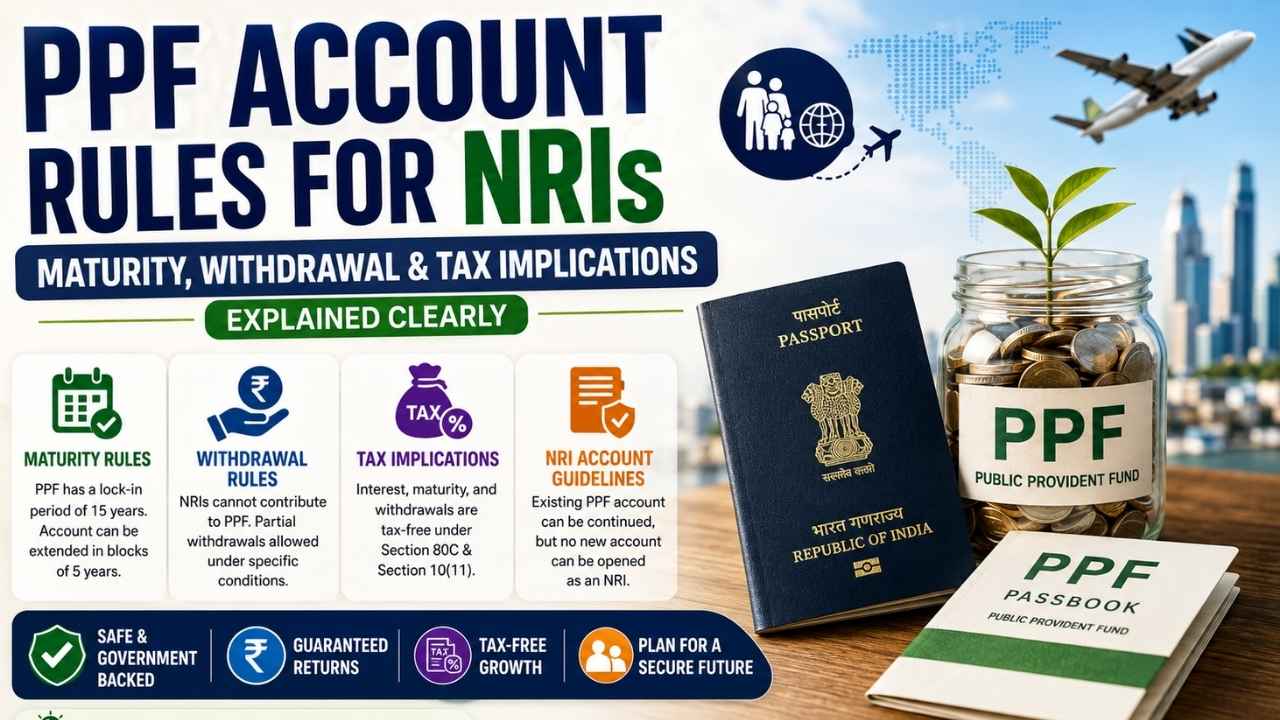
Moving abroad can change the way several Indian financial investments are managed. The Public Provident Fund, commonly known as PPF, is one such investment that needs special attention when an account holder becomes a Non Resident Indian.
Many people who have spent years building a PPF corpus may wonder whether they need to close the account immediately after moving overseas. The answer is not as simple as closing a regular savings account.
An existing PPF account and a new PPF account are treated differently when the account holder’s residential status changes. The original maturity period, contribution rules and options available after maturity also become important.
Here is what existing PPF investors should know before or after becoming an NRI.
Can You Keep an Existing PPF Account After Becoming an NRI?
Becoming an NRI does not mean that an existing PPF account has to be closed immediately.
If the account was opened when the individual was eligible to invest in PPF as a resident, the existing account can continue under the applicable provisions. The important point is that the person’s residential status has changed, so the rules governing the account need to be considered accordingly.
This is particularly relevant for people who move abroad after several years of PPF investment.
For example, someone may have opened a PPF account in India, made regular contributions for several years and then moved overseas for employment. The change in residential status does not automatically erase the accumulated PPF balance.
However, the account holder should inform the concerned bank or post office about the change in residential status and check how the account will be handled going forward.
Can an NRI Open a New PPF Account?
An individual who is already an NRI cannot normally open a new PPF account.
This creates an important difference between an existing account and a fresh investment.
A person who opened a PPF account while eligible as a resident may continue to deal with that existing account under the applicable rules. But someone who has already become an NRI cannot simply start another PPF account in the same way as a resident investor.
Therefore, residential status should be considered before making decisions about opening or continuing a PPF investment.
What Happens to the Existing PPF Balance?
The amount already accumulated in the account remains associated with the existing PPF account.
Becoming an NRI does not mean that the entire balance has to be withdrawn immediately.

The account continues to be governed by the PPF framework, including provisions relating to maturity and withdrawal.
This can be particularly significant for investors who have built a sizeable retirement corpus through regular contributions.
Instead of making a rushed decision after moving abroad, an account holder should first check the account’s opening date, maturity date and the rules applicable to the account after the change in residential status.
Can an NRI Continue Depositing Money Into PPF?
This is one of the areas that requires careful attention.
PPF is not an ordinary savings account where the same operating rules necessarily continue after a change in residential status.
The general PPF scheme provides for deposits subject to its prescribed conditions and annual limits. But an NRI’s position can be different from that of a resident account holder.
Therefore, an NRI should not assume that regular contributions can continue indefinitely under exactly the same conditions that applied before moving abroad.
Before making fresh deposits, the account holder should verify the current rules with the institution where the PPF account is maintained.
This is especially important because depositing money without understanding the applicable provisions can create unnecessary complications later.
What Happens When the PPF Account Reaches Maturity?
The standard PPF account has a long maturity period of 15 years.
For an NRI, the maturity date becomes particularly important because the rules applicable to an existing account may differ from the options available after maturity.
A person approaching maturity should therefore decide in advance whether the accumulated amount should be withdrawn according to the applicable rules or whether any permitted continuation option is available.
The decision should not be based solely on the fact that the person is living outside India. The exact status of the account and the applicable PPF provisions should be checked before taking action.
Can an NRI Extend the PPF Account After Maturity?
PPF normally provides an option to extend an account in blocks of five years after the initial maturity period, subject to the scheme’s conditions.

However, an NRI should be careful before assuming that all extension options available to resident investors will remain available in exactly the same manner.
The residential status of the account holder can affect the treatment of the account after maturity.
This makes the maturity date an important point for reviewing the investment.
If an account is nearing maturity, the investor should check the latest applicable provisions rather than relying on the rules that existed when the PPF account was originally opened.
Can an NRI Withdraw Money From PPF Before Maturity?
PPF is designed as a long term savings instrument, so withdrawals are subject to specific conditions.
Partial withdrawal is generally permitted only after the account has completed the required period under the scheme. The amount that can be withdrawn and the timing of the withdrawal are also governed by prescribed rules.
Therefore, becoming an NRI does not automatically turn the PPF account into an immediately accessible savings balance.
An investor who needs money after moving overseas should first determine whether the account has reached the relevant withdrawal stage and whether the proposed withdrawal meets the applicable conditions.
What About the PPF Interest Rate?
PPF interest is determined by the government and can change periodically.
The interest rate applicable to an account is therefore not something investors should assume will remain fixed for the entire 15 year period.
The rate announced for a particular quarter applies according to the rules of the scheme.
This is one reason PPF should be viewed as a long term government backed savings instrument rather than as a fixed return product with one guaranteed rate for the entire investment period.
For someone who becomes an NRI, the account’s continued treatment should be considered separately from the prevailing interest rate.
Is PPF Tax Free After Becoming an NRI?
PPF has historically been attractive because of its favourable tax treatment under Indian tax rules.

The interest earned and the amount received at maturity generally receive tax benefits under the Indian framework, subject to the applicable provisions.
However, an NRI may become a tax resident of another country.
That creates a separate issue.
A country outside India may have its own rules for reporting foreign investments, interest income and financial assets. Consequently, an investment that receives favourable tax treatment in India may not necessarily receive identical treatment in another country.
For this reason, NRIs should distinguish between Indian tax treatment and the tax laws of their country of tax residence.
If the PPF balance is substantial, professional advice on cross border taxation can be useful.
Does Moving Abroad Affect Your PPF Nomination?
Changing residential status is also a good opportunity to review the nomination details attached to the account.
A nomination can become particularly important when an individual has financial assets in India while living abroad.
The account holder should check whether the nominee information remains correct and whether any personal circumstances have changed since the account was opened.
Keeping KYC and nomination information updated can make future account servicing considerably easier.
What Should You Do Before Moving Abroad?
Someone planning to become an NRI should ideally review the PPF account before leaving India.
Start by checking the date on which the account was opened and calculating the expected maturity date.
Next, review the current balance and contribution history.
The account holder should also contact the bank or post office where the PPF is maintained and ask about the procedure for updating residential status.

It is useful to keep copies of account statements, deposit records and other important documents.
If contributions are being made automatically from an Indian bank account, those arrangements should also be reviewed after the residential status changes.
Should You Close Your PPF Before Becoming an NRI?
There is no universal reason to close an existing PPF account simply because you are moving abroad.
In fact, making a rushed decision without checking the account’s maturity status and applicable withdrawal provisions may not be appropriate.
The right approach depends on factors such as how old the account is, how much money has accumulated, how close it is to maturity and what the investor intends to do with the funds.
Someone with only a short period remaining until maturity may have a very different situation from an investor whose account has just entered its early years.
What If You Already Became an NRI?
If you have already moved abroad and subsequently become an NRI, the first step should be to ensure that your residential status is correctly reflected in your banking and investment records.
You should then check your PPF account’s maturity date and understand the rules governing the existing account.
Do not automatically assume that the resident contribution and extension rules continue unchanged.
Similarly, do not make a premature withdrawal simply because you are now living outside India.
Getting the account status clarified first can help avoid unnecessary financial or administrative problems.
Why the PPF Maturity Date Matters So Much
The maturity date is one of the most important pieces of information for an NRI with an existing PPF account.
Before maturity, the account remains subject to the rules governing the original PPF investment.
After maturity, different options may become relevant.

The account holder therefore needs to plan around this date rather than treating the PPF as an ordinary bank deposit.
Someone who is relocating overseas shortly before maturity should especially review the account because decisions about withdrawal or continuation may have long term consequences.
PPF vs Other Investments After Becoming an NRI
Once a person moves abroad, their overall financial situation can change significantly.
Income may now be earned in a foreign currency, expenses may be spread between India and another country, and taxation can become more complicated.
An existing PPF account can remain one component of the person’s Indian savings portfolio, but it should be considered alongside other investments and financial obligations.
The fact that an investment has worked well for someone while living in India does not automatically mean that the same investment strategy will be optimal after becoming an NRI.
Currency exposure, taxation, liquidity and future plans may all need to be considered.
Final Takeaway
Becoming an NRI does not automatically mean that an existing PPF account has to be closed immediately.
The more important questions concern what happens to the account after the change in residential status, whether further contributions are permitted, what happens at maturity and which withdrawal or continuation options are available.
An NRI cannot normally open a fresh PPF account, while an account that was already opened when the individual was eligible can be treated under the applicable rules.
The safest approach is to check the account’s maturity date, update the residential status with the concerned institution and understand the latest rules before making additional deposits or withdrawing the accumulated corpus.
Taxation also deserves separate attention. PPF may receive favourable treatment under Indian tax rules, but an NRI can also be subject to the tax laws of the country where they are resident.
For investors with a significant PPF balance, checking both the Indian rules and overseas tax requirements before taking action can help avoid an expensive mistake.
Disclaimer: This article is for general informational purposes only and should not be treated as financial, tax or legal advice. PPF and NRI rules can change through government notifications and regulatory updates. Always verify the current provisions with the concerned bank, post office or a qualified tax professional before making an investment or withdrawal decision.