
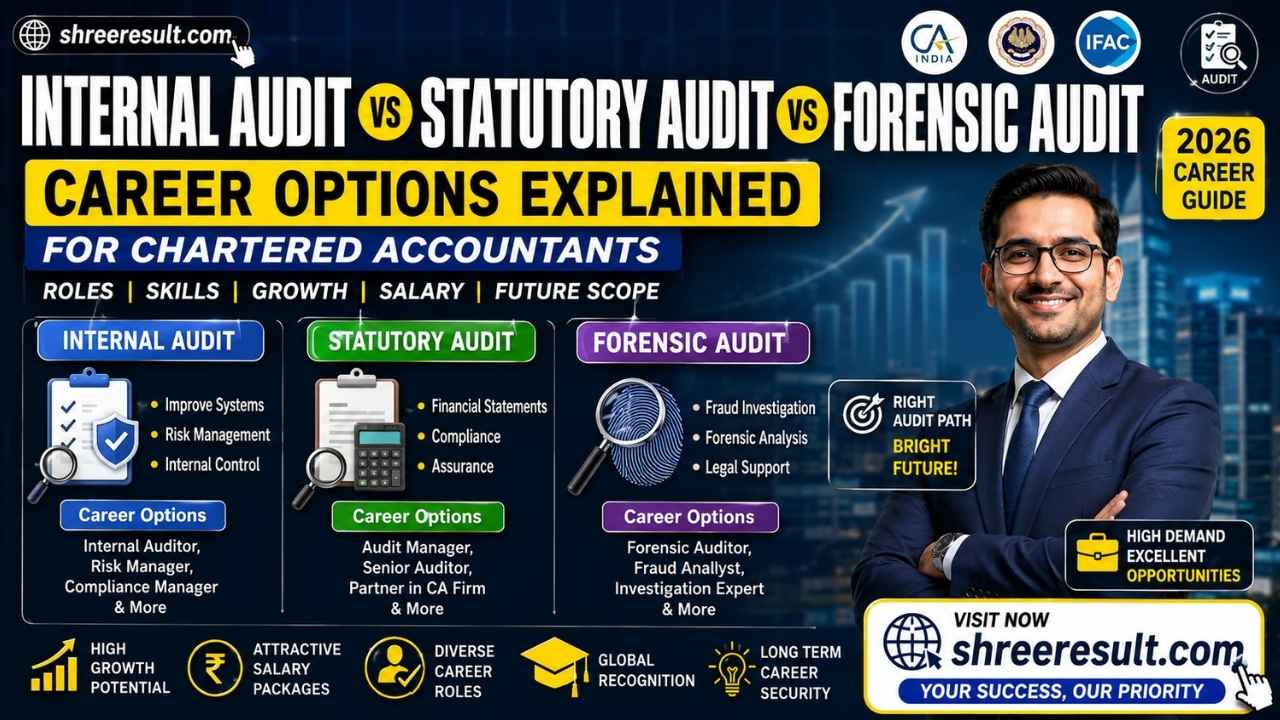
If you are a CA student, doing articleship, or have recently qualified as a Chartered Accountant, there is a good chance that you have asked yourself this question at some point.
Should I build my career in statutory audit, internal audit, or forensic audit?
It is a common confusion because all three fields are connected to auditing, finance, controls, and business. At the same time, the actual work involved in each career can be completely different.
Some CAs enjoy working with financial statements and compliance requirements. Others prefer understanding how a business operates and identifying weaknesses in its systems. Then there are professionals who enjoy investigating suspicious transactions and uncovering financial fraud.
So, which career is actually better?
The honest answer is that there is no single winner. The right choice depends on your interests, personality, career goals, and the kind of professional life you want to build.
Let us understand each option in a simple way.
What Is Statutory Audit?
Statutory audit is probably the most familiar audit field for CA students and practising Chartered Accountants.
In simple terms, it is an audit that is required by law for entities that fall within the applicable legal requirements. The objective is to examine the financial statements of an organisation and determine whether they present a true and fair view of its financial position and performance.
A statutory auditor typically examines areas such as revenue, expenses, assets, liabilities, internal controls, accounting policies, and financial disclosures.
The work is heavily connected with financial reporting, accounting standards, auditing standards, and legal compliance.
For many CAs, statutory audit is the traditional path because it is closely associated with the core identity of the Chartered Accountancy profession.
What Does a Career in Statutory Audit Look Like?
A career in statutory audit can begin with articleship experience and continue through audit firms, large consulting organisations, mid sized CA firms, or eventually through independent practice.
The work often involves interacting with finance teams, reviewing accounting records, checking supporting documents, testing controls, and preparing audit observations.
One of the biggest advantages of statutory audit is that it provides a strong understanding of financial statements.
You get to see how different businesses operate. One client may be a manufacturing company, another may be a technology business, and another may operate in the financial services sector.
Over time, this exposure can help a CA develop strong technical knowledge and industry understanding.
However, statutory audit can also become demanding during the financial closing and audit season. Deadlines can be tight, client coordination can be challenging, and the work may involve long hours during peak periods.
For someone who enjoys accounting, financial reporting, regulations, and traditional audit work, statutory audit can be an excellent long term career.
What Is Internal Audit?
Internal audit is quite different from statutory audit.
While statutory audit focuses primarily on the financial statements and statutory compliance, internal audit looks deeper into how the organisation actually operates.
The internal auditor evaluates business processes, internal controls, risks, operational efficiency, and governance mechanisms.

Instead of asking only whether the numbers are correctly presented, an internal auditor may ask questions such as these.
Is there a weakness in the company’s approval process?
Can an employee bypass an important financial control?
Is inventory being properly monitored?
Are company policies actually being followed?
Is there a risk of financial loss because of a weak business process?
This makes internal audit more closely connected with management, business operations, risk management, and corporate governance.
Why Internal Audit Can Be an Attractive Career for CAs
One of the biggest advantages of internal audit is that it can provide a broad understanding of the entire organisation.
An internal auditor may work with finance, procurement, operations, sales, human resources, technology, and other business functions.
This means you are not always limited to reviewing accounting entries or financial statements.
You may examine how a company purchases raw materials, how it approves expenses, how inventory is managed, or how sensitive data is protected.
This broad exposure can be valuable for CAs who want to move into senior management roles in the future.
Internal audit can also create a strong foundation for careers in risk management, compliance, corporate governance, controllership, and senior finance leadership.
A professional who understands both finance and business controls may eventually move toward roles such as Head of Internal Audit, Chief Risk Officer, Finance Controller, or even CFO.
What Is Forensic Audit?
Forensic audit is perhaps the most exciting and specialised of the three.
If statutory audit is about checking financial statements and internal audit is about improving systems and controls, forensic audit is about investigation.
A forensic auditor is usually brought in when there is a suspicion of fraud, financial manipulation, misappropriation of funds, corruption, or serious financial misconduct.
The work can involve examining bank statements, emails, invoices, accounting records, digital evidence, related party transactions, and unusual financial patterns.
The objective is not simply to identify an accounting error.
The forensic professional may need to determine what happened, how it happened, who was involved, how much financial damage occurred, and what evidence is available to support the findings.
In certain cases, the findings may also become relevant in legal proceedings, regulatory investigations, or disciplinary actions.

Why Forensic Audit Feels Different From Traditional Audit
Forensic audit requires a different mindset.
A traditional auditor may examine transactions to determine whether appropriate evidence and controls exist.
A forensic auditor may go several steps further.
Why did this transaction happen?
Why was this vendor selected?
Is this supplier actually connected to an employee or management person?
Were invoices artificially created?
Was money transferred through multiple entities to hide its original source?
Are there unusual patterns that indicate manipulation?
This investigative approach makes forensic audit attractive for professionals who enjoy problem solving, analysis, financial investigation, and detailed research.
Every case can be different, which means the work may feel less routine compared with regular audit assignments.
The Satyam Case and the Importance of Forensic Investigation
The Satyam scandal remains one of the most widely discussed corporate fraud cases in India.
The case demonstrated how serious financial manipulation can remain hidden when normal reporting and control mechanisms fail to identify deeper problems.
Large scale discrepancies in financial reporting eventually came to light, creating a major corporate governance crisis.
Cases involving significant financial irregularities have increased awareness about the importance of specialised financial investigation.
This is where forensic audit plays a crucial role.
Forensic professionals do not simply rely on whether documents appear to be properly maintained. They may investigate unusual patterns, relationships, transactions, digital records, and other evidence to understand whether deliberate manipulation or fraud has occurred.
The growing focus on corporate governance and financial transparency has made forensic skills increasingly valuable.
The Main Difference Between the Three Careers
Although all three fields involve audit skills, their objectives are very different.
Statutory audit is primarily focused on financial reporting and compliance.
Internal audit focuses on risks, controls, governance, and improving business processes.

Forensic audit focuses on investigating suspected fraud, misconduct, and financial irregularities.
The frequency of work is also different.
Statutory audit generally follows periodic or annual reporting requirements.
Internal audit is often a continuous or planned activity conducted throughout the year.
Forensic audit is generally assignment based and may arise when there is a suspicion, complaint, regulatory issue, dispute, or financial irregularity.
The work environment can also vary significantly.
A statutory auditor may work with finance teams and management during the audit of financial statements.
An internal auditor may regularly interact with different business departments.
A forensic auditor may work with lawyers, investigators, regulators, management teams, digital specialists, and other experts depending on the case.
Which Career Offers Better Salary and Growth?
Salary is important, but it should not be the only factor when choosing a career.
The earning potential in all three fields can become strong with the right experience and expertise.
Statutory audit offers a structured career path, especially within large audit firms and established professional practices. It can also be an attractive choice for CAs who want to eventually build their own practice.
Internal audit can provide stable career opportunities within large corporations, banks, multinational companies, consulting firms, and other organisations. Professionals with strong expertise in risk and controls can move into senior leadership roles.
Forensic audit is a specialised field, and professionals with strong investigation skills can become highly valuable as their experience grows. Opportunities may exist in consulting firms, financial institutions, corporate investigation teams, regulatory environments, and specialised advisory practices.
However, salary figures can vary significantly depending on the city, organisation, experience, technical skills, and role.
Instead of selecting a field based only on the starting package, it is often better to consider where the career can take you after five or ten years.
Which Career Is Best for Someone Who Wants to Start a CA Practice?
For CAs who dream of building their own professional practice, statutory audit can be a natural choice.
It provides direct exposure to clients, financial reporting, taxation, compliance, and audit assignments.
Over time, a practitioner can build relationships with businesses and expand into multiple professional service areas.
Internal audit can also be a strong practice area, especially as companies increasingly focus on risk management and internal controls.
A professional practice can offer specialised internal audit, risk advisory, process review, and compliance services.

Forensic audit can become a highly specialised practice. However, building a reputation in this field may require strong technical expertise, investigative experience, and professional credibility.
Each option can support independent practice, but the path to building that practice may look different.
Which Career Is Best for a Corporate Job?
If your goal is to build a long term career inside companies rather than run your own practice, internal audit can be particularly attractive.
Internal auditors often gain exposure to multiple business functions, senior management, risk committees, and organisational decision making.
This can help develop a strong understanding of how companies actually function beyond their financial statements.
Statutory audit experience can also create excellent opportunities in financial reporting, controllership, accounting, compliance, and finance leadership roles.
Forensic audit can lead to specialised corporate investigation and compliance roles, particularly in larger organisations and financial institutions.
The right option depends on whether you prefer becoming a broad business and finance professional or developing deep expertise in a specialised area.
What Skills Do You Need for Each Career?
Statutory audit requires strong knowledge of accounting, auditing standards, financial reporting, and relevant laws and regulations.
Attention to detail is extremely important because even a small error can affect the reliability of financial reporting.
Internal audit requires analytical thinking and a strong understanding of business processes.
Communication skills are also important because internal auditors often need to discuss findings with management and recommend improvements.
Forensic audit requires curiosity, scepticism, patience, and investigative ability.
A forensic professional should be comfortable examining large amounts of information and identifying patterns that may not be obvious at first glance.
Technology and data analysis skills can also become increasingly valuable in all three fields.
Why Upskilling Matters More Than Choosing the Perfect Career
The reality is that no career remains static.
Statutory auditors now need to understand evolving accounting standards, regulatory changes, and technology based audit procedures.
Internal auditors increasingly need knowledge of enterprise risk, data analytics, cybersecurity controls, and digital business processes.
Forensic professionals may need expertise in financial investigation, fraud examination, digital evidence, data analysis, and legal procedures.
For this reason, continuous learning can often make a bigger difference than the initial career choice.
A CA who keeps developing relevant skills may find opportunities to move between related areas over time.

For example, someone with statutory audit experience can move into internal audit or risk advisory.
An internal auditor can specialise in fraud risk and eventually develop forensic expertise.
Career paths do not always have to remain fixed.
How Should a CA Choose Between the Three?
The best choice often depends on your personality.
Choose statutory audit if you enjoy financial statements, accounting, compliance, audit methodology, and traditional CA practice.
Choose internal audit if you are interested in understanding businesses, identifying risks, improving processes, and working closely with management.
Choose forensic audit if you enjoy investigation, problem solving, analysing suspicious transactions, and uncovering the story behind financial irregularities.
It is also worth considering your preferred lifestyle.
Some audit roles can involve intense deadlines and busy seasons. Others may involve regular interaction with business teams and continuous projects. Forensic assignments can sometimes be unpredictable because complex investigations may require extensive analysis and urgent attention.
There is no universally perfect option.
The best career is usually the one where your skills and interests allow you to become exceptionally good.
Final Thoughts
Statutory audit, internal audit, and forensic audit are all strong career options for Chartered Accountants in India.
Statutory audit offers a solid foundation in financial reporting, compliance, and professional practice.
Internal audit provides broader exposure to business processes, risk management, and corporate governance.
Forensic audit offers a specialised and intellectually challenging path focused on financial investigation and fraud detection.
Instead of asking which career is the best for every CA, ask which career is the best fit for you.
Think about the type of work you enjoy, the skills you want to develop, and where you see yourself in the future.
You do not need to have your entire career figured out on the first day of articleship or immediately after qualifying.
Start by building strong fundamentals. Gain practical exposure. Keep learning. Explore different opportunities whenever possible.
The CA qualification gives you a powerful foundation. What ultimately shapes your career is how you use that foundation to build expertise, credibility, and professional value.
Whether you choose statutory audit, internal audit, or forensic audit, success will depend far more on your skills, experience, and willingness to keep growing than on the title of the career you choose.