
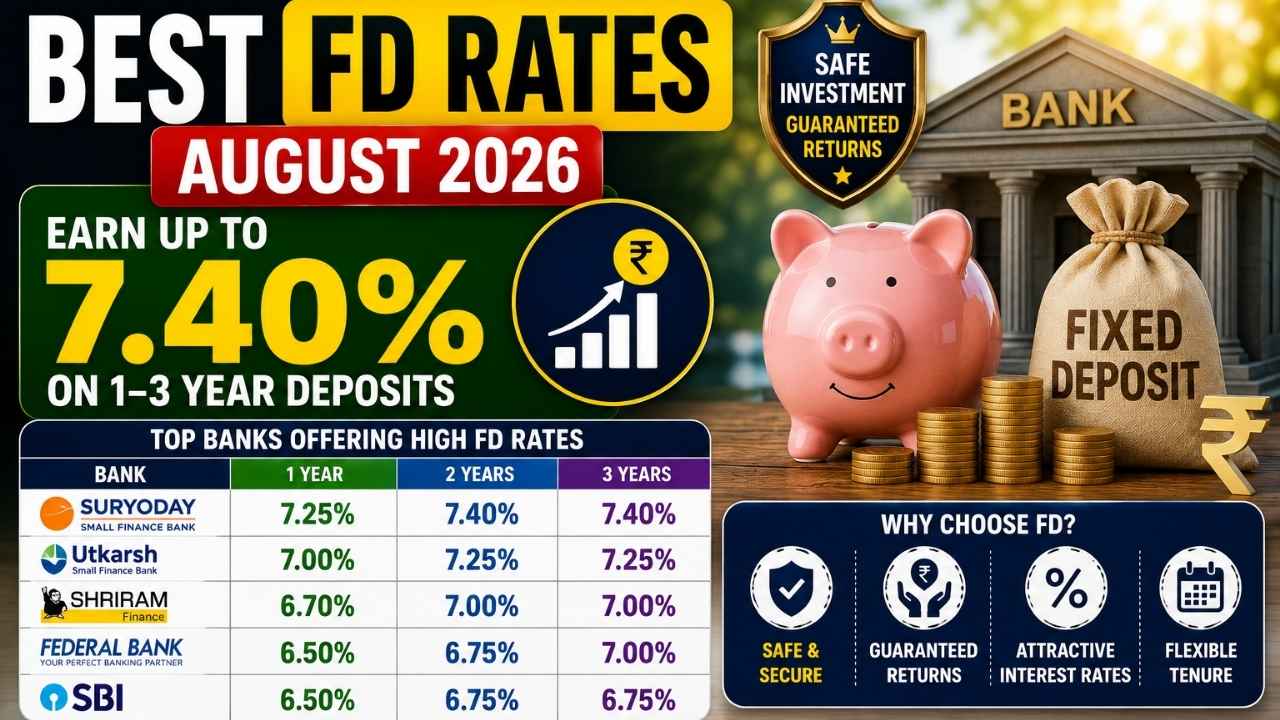
Fixed deposits continue to be a popular savings option for Indian investors who prefer predictable returns and do not want their money exposed to daily market fluctuations. For people who do not want to lock their savings away for five or ten years, a one to three year FD can offer a useful middle ground between earning interest and keeping the money relatively accessible.
However, FD rates are not the same across banks. Smaller private banks, mid sized lenders and some public sector banks may offer higher rates than the country’s largest banks. Senior citizens can also receive an additional interest rate benefit, making the comparison even more important.
Based on the rates provided for this comparison, IDFC FIRST Bank is among the strongest options at the upper end, while Bandhan Bank and RBL Bank also offer competitive rates.
Where FD Interest Rates Stand for 1 to 3 Years
The rates available for one to three year deposits vary considerably between banks. In the figures provided, IDFC FIRST Bank offers rates ranging from 6.50% to 7.40% for general customers, with senior citizen rates reaching 7.90%.
Bandhan Bank and RBL Bank are also near the top of the comparison. Bandhan Bank offers up to 7.25% for regular depositors, while RBL Bank offers up to 7.20%.
Tamilnad Mercantile Bank and IndusInd Bank also feature among the banks offering relatively attractive rates within the one to three year range.
By comparison, major banks such as SBI, HDFC Bank, ICICI Bank and Axis Bank have rates clustered around the 6.25% to 6.45% range for general customers in the figures supplied.
Here is the complete comparison:
| Bank | General Public | Senior Citizens |
|---|---|---|
| IDFC FIRST Bank | 6.50%–7.40% | 7.00%–7.90% |
| Bandhan Bank | 7.00%–7.25% | 7.50%–7.75% |
| RBL Bank | 7.00%–7.20% | 7.50%–7.70% |
| Tamilnad Mercantile Bank | 6.60%–7.10% | 6.70%–7.20% |
| IndusInd Bank | 6.75%–7.00% | 7.25%–7.50% |
| South Indian Bank | 6.20%–6.80% | 6.45%–7.30% |
| Kotak Mahindra Bank | 6.50%–6.70% | 7.00%–7.20% |
| Karnataka Bank | 6.15%–6.65% | 6.55%–7.05% |
| Punjab National Bank | 6.20%–6.60% | 6.75%–7.10% |
| IDBI Bank | 6.20%–6.50% | 6.70%–7.00% |
| Axis Bank | 6.25%–6.45% | 6.75%–6.95% |
| HDFC Bank | 6.25%–6.45% | 6.75%–6.95% |
| ICICI Bank | 6.25%–6.45% | 6.75%–6.95% |
| State Bank of India | 6.25%–6.40% | 6.75%–6.90% |
| Union Bank of India | 6.20%–6.40% | 6.45%–6.65% |
| Central Bank of India | 6.20%–6.25% | 6.70%–6.75% |
| Bank of Baroda | 6.10%–6.25% | 6.60%–6.75% |
| Bank of Maharashtra | 5.25%–6.15% | 5.75%–6.65% |
The rates above are based on the figures supplied for this article. FD rates can change depending on the deposit tenure, amount, customer category and the bank’s latest rate schedule.
IDFC FIRST Bank Offers One of the Highest Rates
Among the banks in this comparison, IDFC FIRST Bank has the highest rate at the upper end for both regular depositors and senior citizens.

General customers can earn between 6.50% and 7.40%, depending on the applicable tenure. For senior citizens, the range goes from 7.00% to 7.90%.
The highest rate is particularly notable for investors who are looking for a relatively short deposit period but still want a return above what many large banks currently offer.
However, the highest advertised rate should not automatically be treated as the best choice. Investors should check the exact tenure required to qualify for the rate, premature withdrawal conditions and other terms before opening the FD.
Bandhan Bank and RBL Bank Also Offer Competitive Rates
Bandhan Bank is another strong contender in the comparison. Its general customer rates range from 7.00% to 7.25%, while senior citizens can receive between 7.50% and 7.75%.
RBL Bank offers 7.00% to 7.20% to regular depositors and 7.50% to 7.70% to senior citizens.
The difference between these banks and larger lenders can become meaningful when a substantial amount is invested for several years.
For example, even a rate difference of one percentage point can make a noticeable difference in the interest earned over the full deposit period. Investors should therefore compare the rate applicable to their exact tenure rather than comparing only the highest rate advertised by each bank.
Senior Citizens Can Get an Additional Rate Benefit
Senior citizens generally receive an additional interest rate over the standard rate offered to regular customers.
In the figures provided, the senior citizen advantage varies depending on the bank and applicable tenure. The additional rate can be particularly valuable for retirees who depend on fixed deposit interest to supplement their regular income.

For example, IDFC FIRST Bank’s senior citizen rate reaches 7.90% in this comparison. Bandhan Bank and RBL Bank also offer rates of up to 7.75% and 7.70%, respectively.
But senior citizens should look beyond the headline interest rate. If the FD is intended to provide regular income, the interest payout option can be just as important as the advertised rate.
Why a 1 to 3 Year FD Can Be Useful
A one to three year FD can be suitable for investors who want a defined investment horizon without locking away their savings for a very long period.
A shorter FD tenure may be useful when the investor expects to need the money for a known future expense, such as education, a home purchase, a planned large payment or other financial commitments.
At the same time, investors should remember that premature withdrawal may result in a lower effective interest rate or a penalty, depending on the bank’s terms.
Therefore, the FD tenure should ideally match the period for which the money can remain invested.
Should You Choose a Small Bank for a Higher FD Rate?
A higher FD rate can be attractive, but interest rate should not be the only factor behind the decision.
Before depositing a large amount, investors should examine the bank’s financial position, applicable deposit terms and the level of protection available through deposit insurance.
The Deposit Insurance and Credit Guarantee Corporation, or DICGC, generally provides deposit insurance of up to ₹5 lakh per depositor per bank, subject to the applicable rules and coverage framework.

This makes it important to understand how much money is being placed with a particular bank, especially when the deposit amount is substantially higher than the insured limit.
FD Safety Is About More Than the Interest Rate
Two banks may offer different interest rates, but the decision should not be based entirely on which one pays the highest percentage.
Investors should compare:
- The exact FD tenure
- Interest rate applicable to that tenure
- Senior citizen benefit, if applicable
- Cumulative or non cumulative option
- Interest payout frequency
- Premature withdrawal rules
- Applicable penalties
- Deposit insurance coverage
- Tax treatment of the interest
- The bank’s overall financial strength
A slightly lower interest rate may sometimes be acceptable if the investor values a particular bank’s services, convenience or other characteristics.
Cumulative FD or Regular Interest Payout?
The choice between cumulative and regular interest payout depends on the investor’s objective.
Under a cumulative FD, interest is generally accumulated and paid along with the principal at maturity, subject to the bank’s applicable compounding terms.
This can be useful for someone who does not need regular cash flow and wants to allow the deposit to grow until maturity.
A non cumulative FD, on the other hand, can provide interest at regular intervals such as monthly, quarterly, half yearly or annually, depending on the product.
This may be more suitable for retirees or other investors who want periodic income from their savings.

What Happens to Your FD Interest for Tax Purposes?
FD interest is generally taxable under the applicable income tax rules. The interest earned does not automatically become tax free simply because the money is invested in a fixed deposit.
Therefore, investors comparing two FD rates should also consider the post tax return.
A higher advertised interest rate may not necessarily produce a substantially higher amount in hand after taxes, depending on the investor’s income and applicable tax rules.
Senior citizens should therefore consider their overall taxable income when planning FD investments.
Don’t Invest Only Because a Bank Shows the Highest Rate
The highest rate can be attractive, but investors should first identify the exact tenure associated with it.
FD rates are usually displayed as ranges because different maturities can have different interest rates. A bank offering a maximum rate of 7.40% does not necessarily mean every one year or two year deposit will earn 7.40%.
The actual rate depends on the specific tenure and product selected.
Investors should therefore verify the rate applicable on the day they book the FD and read the terms carefully before transferring their money.
How to Choose the Right FD for Your Money
There is no single FD that is ideal for every investor.

Someone looking for maximum interest may prefer to compare banks offering rates near the top of the market. A retiree may place greater importance on regular interest payments. Another investor may prioritise convenience and keep the FD with an existing bank.
For larger amounts, diversification can also be considered instead of putting the entire sum into one deposit.
For example, an investor with a large amount could potentially divide the money across different banks and different maturity dates, depending on their financial objectives and risk considerations.
This approach can also create a staggered maturity schedule, giving the investor access to portions of the money at different times.
The Bottom Line
The one to three year FD market offers a wide range of interest rates, and the difference between banks can be significant.
Based on the rates provided for this comparison, IDFC FIRST Bank has the highest maximum rate at 7.40% for general customers and 7.90% for senior citizens. Bandhan Bank and RBL Bank are also near the top, while several large banks offer rates in the 6.25% to 6.45% range for general depositors.
However, the best FD is not necessarily the one with the highest advertised rate. Investors should check the exact tenure, interest payout structure, premature withdrawal conditions, taxation and deposit insurance before making a decision.
Most importantly, FD rates can change. The figures used here are based on the rates supplied for this comparison and should be independently verified with the respective bank before opening a deposit.
Disclaimer: This article is for general informational purposes only and should not be considered investment advice. Investors should verify current FD rates and terms with the respective bank and consider their own financial circumstances before investing.